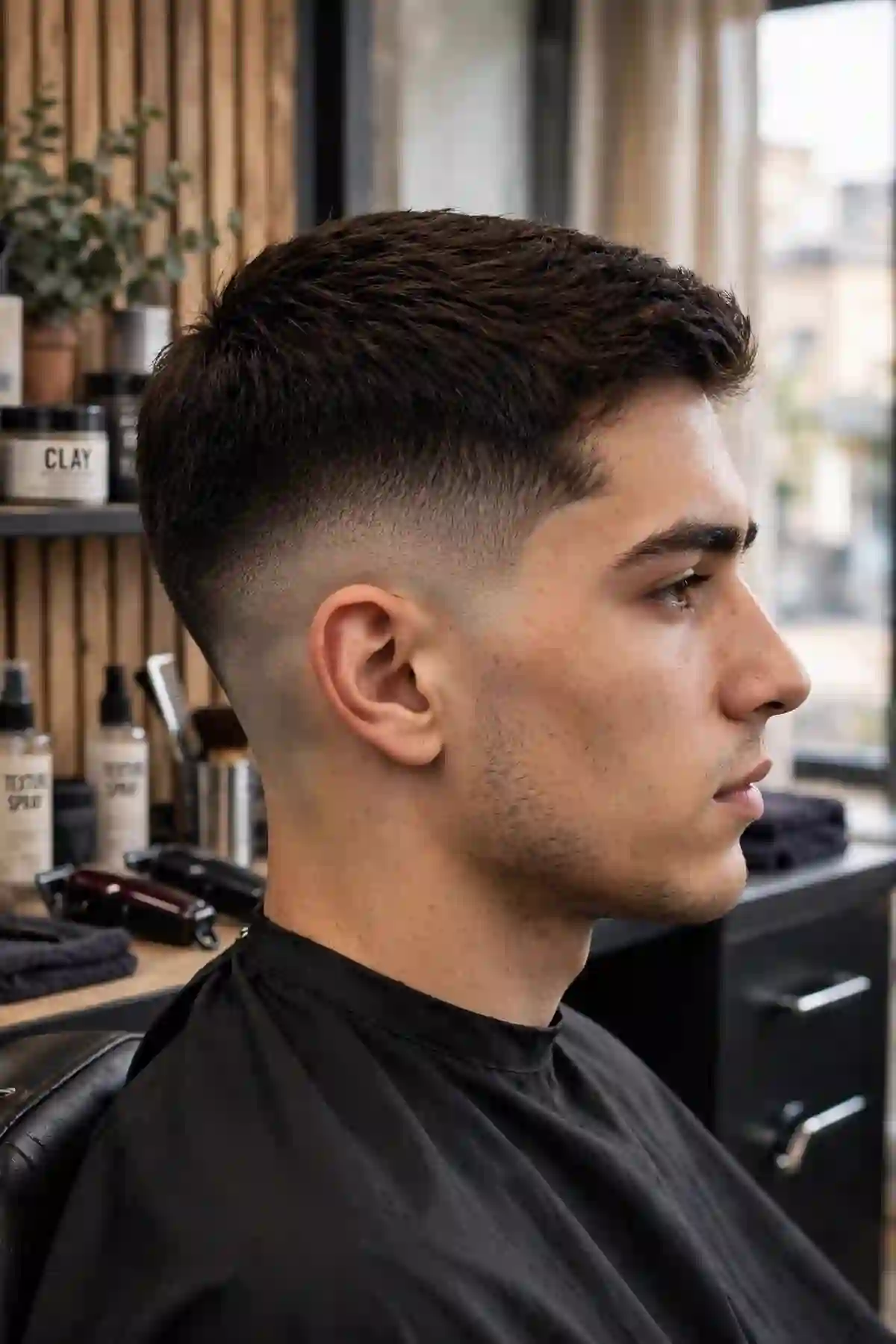
Straight hair is the hair type that asks for a mid taper fade most — and judges it hardest. A good blend looks flawless: the gradient runs smooth from skin to top. But there is no curl to hide behind, so every shelf and step shows exactly as the barber left it.
That makes this cut a barber test as much as a hairstyle: a patient blender makes straight hair wear a mid taper better than almost any other type; a rushed one leaves lines that announce themselves.
This guide covers why the cut suits straight hair, the honest problems it brings, how the guards behave differently than on curls, the best styles on top, the exact words to say at the chair, and the routine that stops hair lying flat by lunchtime.
The full breakdown is in the complete mid taper fade guide; if you are still deciding between a taper and a full fade, fade vs taper settles it side by side.
The gradient reads clean. A taper is a gradient — hair getting longer step by step. Straight hair lies flat in one direction, so each step sits evenly and the eye reads one smooth slope. Curly hair can blur a blend; straight hair displays it. When the blend is good, nothing looks sharper.
The edges stay neat. A tidy neckline on straight hair holds its shape cleanly, because the hair around it lies in the same direction instead of springing back. The cut looks freshly done for longer between visits — at least around the edges.
The top is a blank canvas. Straight hair can be worn forward, up, back or to the side without fighting a curl pattern. The same mid taper can carry a fringe, a quiff or a side part — the sides stay constant, the top is a free choice.
It suits almost every setting. A mid taper on straight hair reads tidy without reading severe — office, school, wedding — and grows out more gracefully than a skin fade, because the blend starts with more length.
Straight hair rewards a good barber and exposes a careless one.
Every line shows. On curly hair, a small step between guards disappears into the texture. On straight hair, the same step sits there as a visible shelf — a line where one guard length meets the next. It is the most common straight-hair complaint, and it is a blending problem, not a guard problem — fixed with lever work and half-guards.
The porcupine stage. One to two weeks after the cut, the short side hair is too long to lie down and too short to bend — so it sticks straight out, and the sides look fuzzy and wider than on day one. It passes as the hair grows; a tidy at the two-week mark skips it entirely. Nobody warns men about it, so here is the warning.
The top lies flat. Straight hair has no natural lift. Left to itself the top falls against the head, and on fine hair it can look thin — scalp showing at the parting and crown even when the hair is not thinning. The fix is texture in the cut (point cutting) and lift in the styling — both covered below.
Cowlicks fight back. A strong cowlick at the front hairline will split a fringe or a side part exactly where you least want it, every morning. You cannot beat a cowlick, only work with its direction — part on the side it grows toward, or wear the front forward so it hides inside the fringe.
Oil shows faster. Straight hair lets scalp oil travel down the shaft instead of sitting at the roots, so the top can look greasy by the evening of a wash day, especially on fine hair.
The numbers are the same as on any hair type. The behaviour is almost the mirror image of curly hair.
The same guard reads longer. Coily hair shrinks as it dries, so a guard's number reads shorter than the clipper says. Straight hair does not shrink — a 2 looks like a full 2. Expect yours to look a touch longer and softer than the same numbers on curly hair in photos. The full map is in mid taper fade guard numbers.
The steps show more, so the blending does the work. Each length lies flat and visible, so the jumps between guards are easier to see. Good barbers use the clipper lever — half-steps between numbers — and clipper-over-comb at the top of the blend. Judge a new barber by this: time spent in the blend, not speed through it.
Skin or shadow at the bottom? Skin (bare blade) gives the strongest contrast — and shows the steps above it most clearly. Shadow (0 or 0.5) is the forgiving default: a hint of hair at the bottom softens the whole slope and hides small imperfections. First mid taper? Start with the shadow — you can go to skin once you trust the blend.
For reference, the common guard sizes leave roughly this much hair: a number 1 about 1/8 inch, a number 2 about 1/4 inch, a number 3 about 3/8 inch. Brands differ slightly, so a good barber checks the actual length rather than trusting the number alone.
The bottom guard, guard by guard:
| Bottom guard | Length left | How it looks on straight hair | Pick it if |
|---|---|---|---|
| 0.5 | About 1/16 inch | Very close, with scalp showing through — every step is visible | You want a sharp look and will rebook every two weeks |
| 1 | About 1/8 inch | A soft shadow finish — the safe default | You are unsure, or it is your first fade |
| 2 | About 1/4 inch | Softer, with a fuller side; the edge grows out more gently | You have fine hair or a conservative workplace |
Choosing for the first time? Start with a number 1 at the bottom and blend up through a 2 and a 3.
Two more finishes the table does not cover:
The taper underneath stays the same; these are the tops worth wearing.
The natural home of this style is straight hair. The top falls forward, the front edge point-cut into pieces, and the fringe sits flat and clean instead of curling up. It covers a big forehead, forgives a receding hairline, and needs two minutes a day. Full guide: mid taper fade with textured fringe.
The professional classic. Straight hair parts cleanly and stays where it is combed, so the part line stays sharp all day. Ask the barber to find your natural part — fighting for one an inch from where the hair wants to split is a daily losing battle. A hard part (shaved line) is optional.
Straight hair can do height — it just cannot do it alone. A quiff here is built with a blow-dryer and a pre-styler: dry the front up and back with heat, then hold it with matte paste. Done right, the most polished version of this cut; skipped, the front falls forward by midday.
The top is left longer (three to four inches) and combed straight back. Straight hair slicks back more cleanly than any other type — no frizz, no stray curls. It needs length, a little shine product rather than matte, and tight sides so the top does not look disconnected.
The barber point-cuts the top heavily so the ends sit at different lengths; you style it by pushing it around with matte paste or texture powder. The lowest-effort good look on straight hair, because the texture is cut in — the hair just needs disturbing in the morning.
The top taken down to a 3 or 4 guard, blended into the mid taper. No styling, no flat-top problem, no cowlick battles — the hair is too short to misbehave. For men who want the taper's clean outline with none of the top's demands; it grows into a textured top in about a month.
"I want a mid taper fade. Start the blend at the temple — a number 1 at the bottom, up through a 2 and a 3, and blend it with the lever so there are no lines. Leave the top long enough to wear [forward as a fringe / up as a quiff / in a side part], and point-cut the ends so it does not lie flat. Taper the neckline. Here is a photo."
Adjust the script for your hair:
Three chair habits that help any version of the script: bring photos from the front AND the side (the blend is judged from the side, and a front photo does not show it); ask the barber to check the blend with a comb before he finishes — a comb drawn through the transition shows any shelf right away, while there is still time to blend it out; and tell him how short you will let it get before a touch-up, so he can plan the guard — a bottom chosen for a two-week cycle is not the same as one chosen for four.
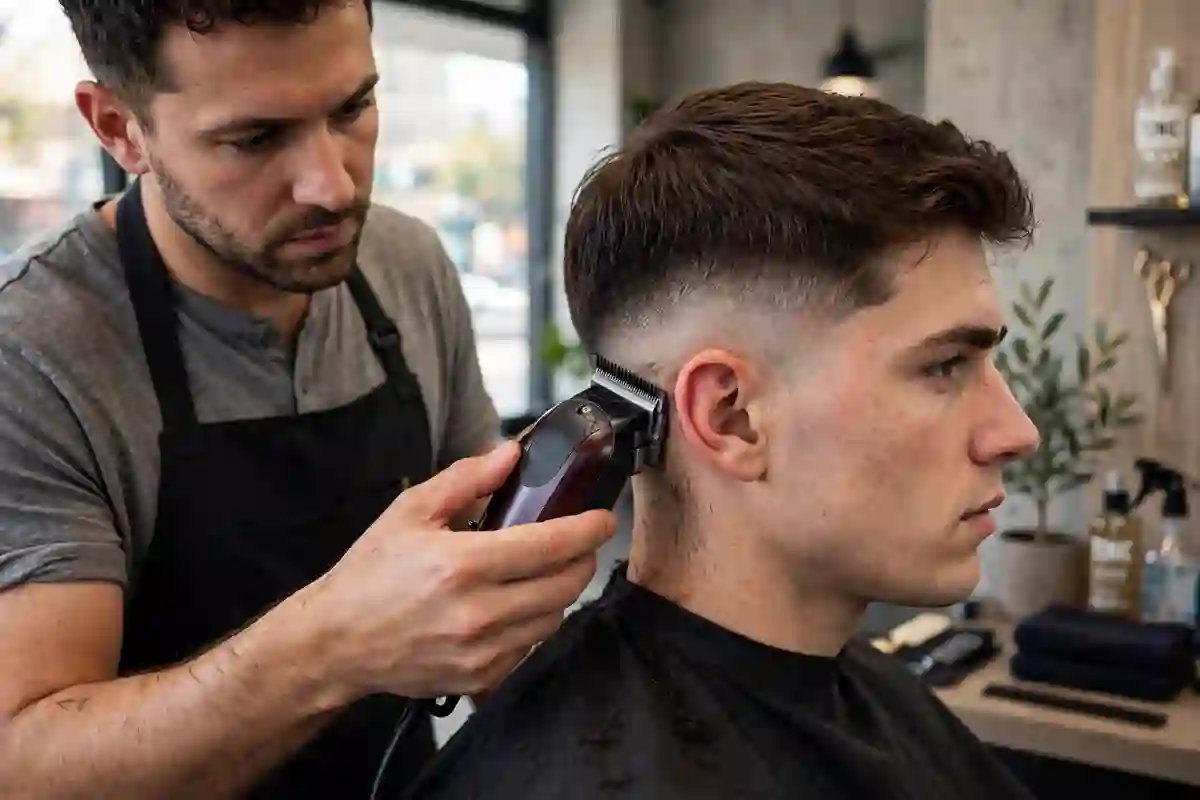
Straight hair's daily battle is flatness — won in a fixed order: heat first, product second.
Blow-dry first, and dry against the lie. The direction hair dries in is the direction it stays in. Dry the top upward and against the way it wants to fall, holding the roots up while the heat sets them. Two minutes of this beats any product applied to flat, dry hair afterwards.
Use a pre-styler. A light spray — sea-salt spray is the common one — worked into damp hair before drying gives grip and body, so the hair does not slide flat. Fine hair especially needs this; paste alone just weighs it down in clumps.
Texture powder, then matte paste. A small shake of powder at the roots, rubbed in with fingertips, gives a rough, lifted finish in ten seconds. Then a pea-sized amount of matte paste, warmed between the palms, sets the direction and separates the ends. Matte, not shine — shine reads as oil by the afternoon. And go easy: powder is the easiest product to overuse.
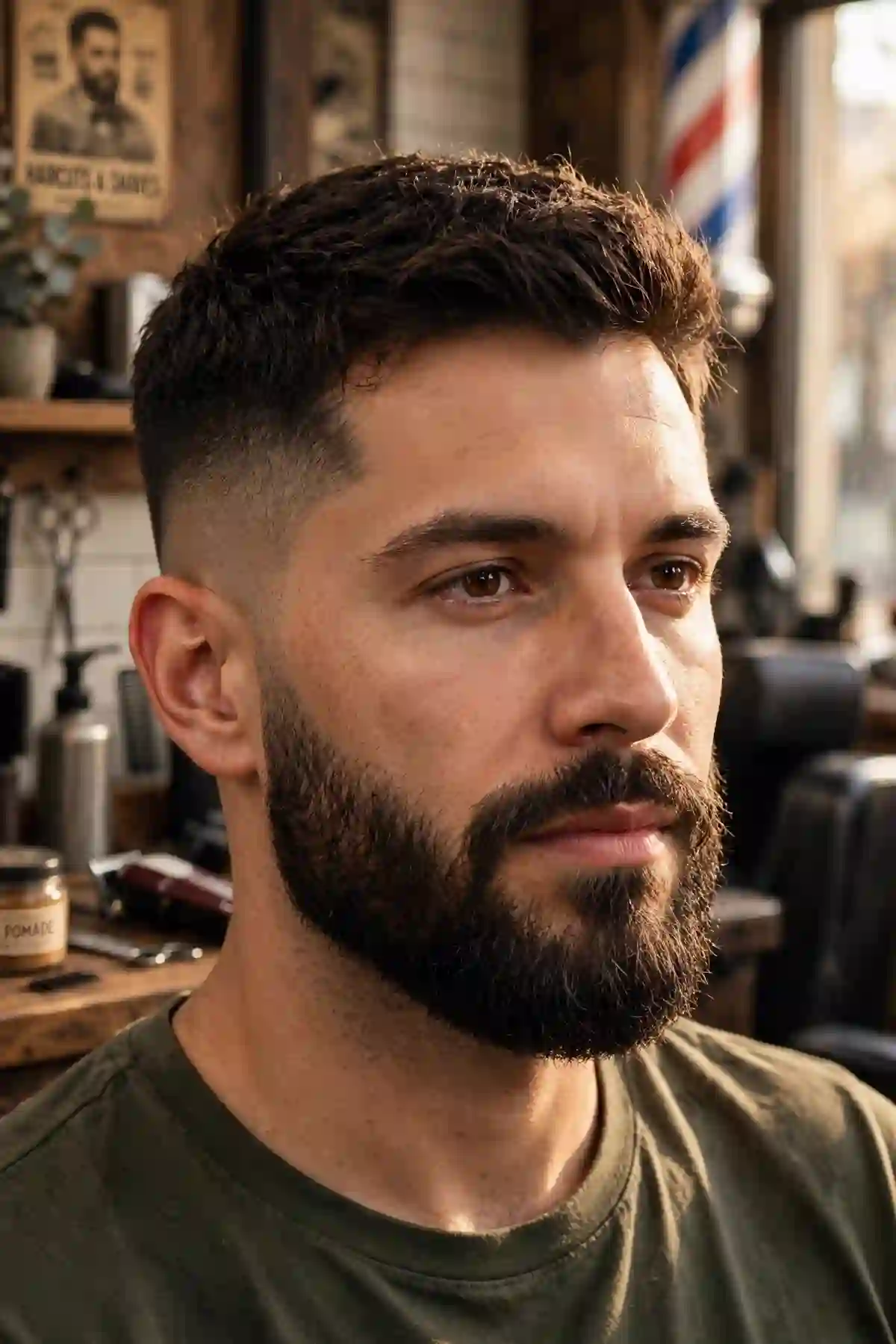
Wash rhythm for oil-prone hair. Most men with this cut wash every one to two days. On in-between days, dry shampoo at the roots in the morning absorbs oil before it travels. Washing more often is fine — just use a gentle shampoo, because stripped hair produces oil faster to compensate.
The daily routine (2–3 minutes):
Shape-by-shape detail is in best mid taper fade for your face shape.
Straight hair shows edge growth sooner than curly hair does — it lies against the skin, so regrowth at the neckline and ears is visible at once. The full timeline is in how long does a mid taper fade last; the straight-hair version:
The rhythm: a full cut every three to four weeks, or a quick tidy at week two to three to skip the porcupine stage.
These are sample scenarios based on common requests, not real clients.
Hamza, 26, the shelf line. His fade looked perfect in the barber's mirror and striped in daylight — a hard shelf where the 1 met the 2, clipped guard-to-guard with the lever closed. Next visit he asked for the blend worked with the lever open between numbers, and the shelf never came back. Same guards, different blending.
Leo, 31, the flat top. His top lay flat by ten every morning; he had concluded his hair was "too thin for a quiff." It was not thin — it was untextured. The barber point-cut the top; Leo swapped heavy pomade for a pre-styler, an upward blow-dry and matte paste. The quiff held all day.
Tomas, 23, the splitting part. His side part split open at the front every day by noon, exactly at his cowlick. The fix was not stronger product — it was moving the part to the other side, the direction the cowlick already grew. The part stayed shut with no product at all on good days.
A visible shelf line in the blend. The most common straight-hair problem: the barber jumped guard-to-guard without half-steps. Fix at the chair — ask for the line blended out with the lever half-open or clipper-over-comb. No home fix exists; prevention is a slow-blending barber, and saying "no lines" first.
Porcupine sides at week two. The short side hair is at the length where it can only stand up. Fix: wait it out (it lies down by week three), weigh it down with a little product meanwhile, or book the tidy at week two and skip the stage.
The top lies flat by midday. Almost always a styling-order problem: product on dry, flat hair cannot lift it. Fix: pre-styler on damp hair, blow-dry against the lie, then finish. If it still falls, the top needs point cutting at the next visit.
The fringe splits at the cowlick. The fringe falls exactly where the cowlick pushes it apart. Fix: wear it longer and more textured so the split reads as separation, sweep it to the cowlick's side, or move to a side part on that side.
The sides look see-through. On fine straight hair, a 0.5 or skin bottom shows the scalp and makes the whole head look thinner. Fix: raise the bottom guard to a 1 or a 2 — a slightly softer taper, noticeably thicker-looking hair.
Greasy by the evening. Straight hair moves oil down the shaft through the day. Fix: dry shampoo at the roots in the morning (before the oil spreads), a wash every one to two days, and matte products only.
Yes — arguably the hair type the cut shows off best. Straight hair lies in one direction, so the gradient reads smooth and the edges stay neat. The trade is honesty: a poor blend shows as it never would on curls, so the barber matters more than the numbers.
Because straight hair lies flat, the steps between guard lengths stay visible as shelves instead of disappearing into texture. Lines come from jumping from one guard straight to the next; a barber fixes them with the clipper lever (half-steps) and clipper-over-comb.
In order: pre-styler on damp hair, blow-dry upward and against the way the hair wants to fall, texture powder at the roots, matte paste to finish. Underneath it all, the top must be point-cut — flat-cut hair gives product nothing to grip.
A light pre-styler (sea-salt spray) for body, texture powder for lift, a matte paste to set the direction — in that order, in small amounts. Avoid heavy pomades and shine products: they weigh the top down and read as grease by afternoon.
Every two to three weeks, because straight hair shows edge growth quickly — neckline and ears blur first. Many men book a full cut every three to four weeks with a tidy in between, which also skips the porcupine stage.
Shadow (0 or 0.5 at the bottom) is the safer default — it softens the gradient and hides small imperfections. Skin gives stronger contrast and looks superb over a flawless blend, but shows every step. Start with shadow; move to skin once you trust the blending.
Straight hair is the fringe's natural home — it falls forward cleanly and shows the point-cut texture exactly as cut. Keep the front between the hairline and the eyebrows, the edge point-cut rather than blunt, and style it forward with matte clay. Full breakdown: the textured fringe guide.
Say exactly that — "my hair lies flat" — and ask for point cutting on top to take weight out of the ends and create texture, plus enough length left to style upward. A barber who knows the top falls flat cuts it differently.
Yes — fine straight hair wears this cut well, with two adjustments. Keep as much density on top as possible: light point cutting for movement, never aggressive thinning, which makes fine hair look even thinner. And keep the bottom guard at a 1 or a 2 — shorter sides show the scalp through and undo the fullness you are protecting on top.
Yes — it is one of the best cuts for it. The taper removes the excess bulk around the temples and neckline while the top keeps its length for styling. Ask the barber to control the weight through the sides so they do not stick out as the hair grows; thick straight hair left unmanaged at the sides is what creates the wide, boxy silhouette men complain about at week two.
It is the classic pairing. Straight hair parts cleanly and holds the line sharply all day, and the taper keeps the sides controlled without making the cut look severe. Ask the barber to find your natural part rather than forcing one where the hair does not want to split, and expect to spend about a minute with a comb and a little product each morning.
A mid taper fade on straight hair is a high-definition haircut: the blend, the edges and the top show exactly as they were made — its risk and its reward. Choose a barber who blends with the lever, start with a shadow finish, get texture point-cut into the top, and run the three-minute routine: heat first, product second.
Still choosing the top? Start with the textured fringe for the easiest daily wear, and keep the complete mid taper fade guide for the full picture of the cut underneath them all.
← Back to the complete guide: Mid Taper Fade — styles, guard numbers & barber tips
Also see: What is a mid taper fade? — the plain-English definition and who it suits. Mid taper fade guard numbers — what 0.5, 1, 2 and 3 really look like. Best mid taper fade for your face shape — the shape-by-shape guide. And Mid taper fade with textured fringe — the top straight hair wears best.