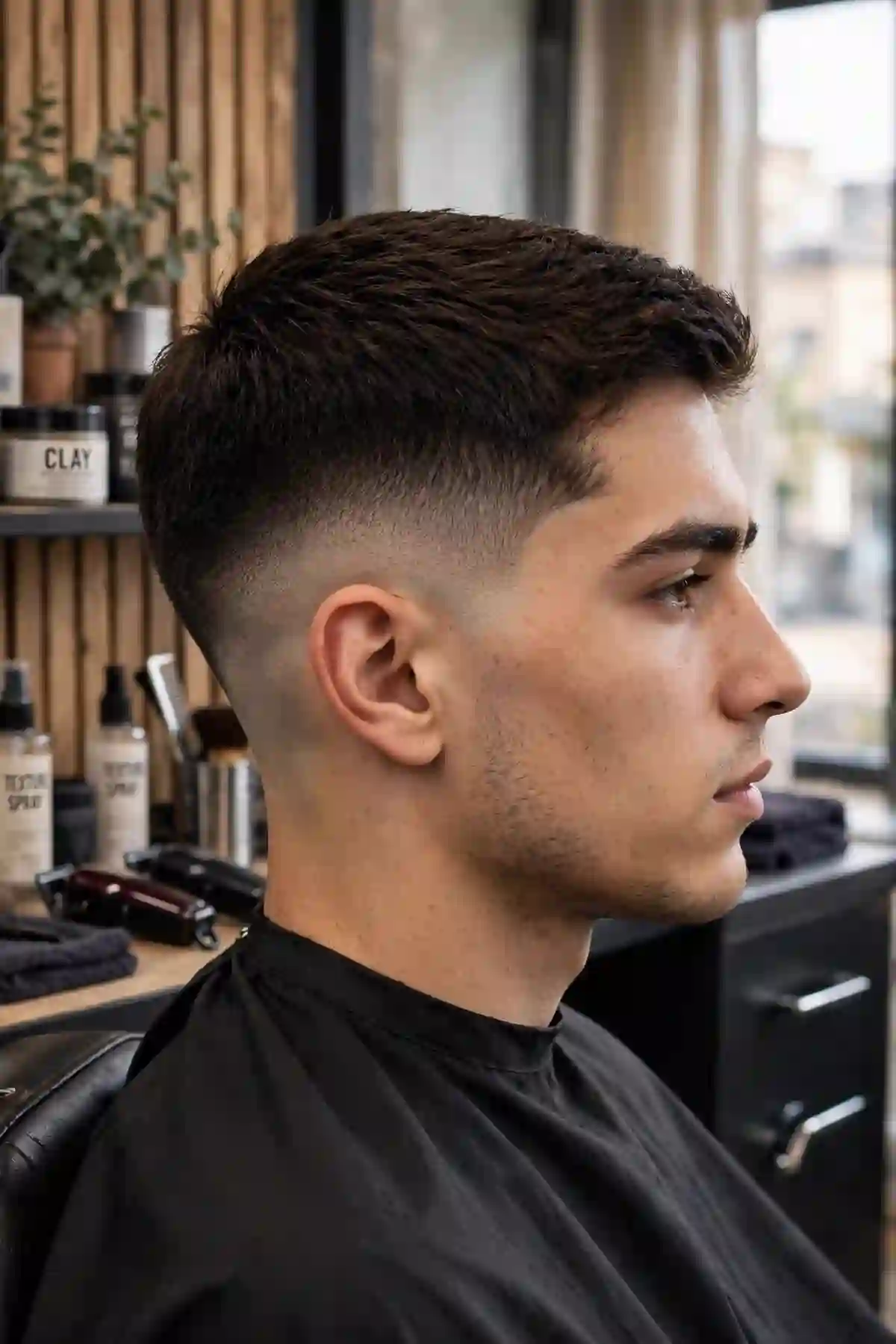
A mid taper fade with a beard is one cut, not two. The hair on top fades down the sides, the beard fades up from the jaw, and they meet at the sideburn — and when that meeting point is blended properly, the whole head reads as a single shape. When it is not, you get the most common complaint in the barber's chair: a sharp haircut sitting on top of a beard that looks like it belongs to someone else.
This guide is the practical version: why the mid taper is the best fade to pair with a beard, how to match beard length to the taper, where the cheek line and neckline should sit, the exact words to say to your barber, and how to keep haircut and beard on the same schedule when they grow at different speeds.
Three things make this pairing work where other fades struggle.
The meeting point is in the right place. A mid taper's blend sits around the temple and above the ear — exactly where the sideburn begins. The barber can fade the hair down into the sideburn and fade the beard up into it in the same pass. With a high fade, the blend starts above the sideburn, so the beard is left hanging below a shaved patch. With a low taper, the blend barely reaches the sideburn at all, and the join looks bulky.
The taper keeps its length where the beard needs it. A mid taper leaves more hair on the sides than a skin fade. That matters because the sideburn is the bridge: it needs enough hair to blend into the beard's top edge. Shave it to skin and the bridge disappears.
The balance is built in. A beard adds weight to the lower half of the face. A mid taper adds clean definition to the upper half. Together they frame the face from both ends — which is why the combination photographs so well and why barbers recommend it to men growing a beard for the first time.
If you are still choosing between fade heights, fade vs taper compares them side by side, and the complete mid taper fade guide covers the cut itself in full.
The beard and the taper should be in proportion. A heavy beard with a tight skin taper looks top-heavy in reverse; a light stubble with a soft taper can look unfinished. Match them like this:
The lightest beard, and the easiest pairing. Ask for a shadow taper — a 0 or 0.5 at the very bottom — so the haircut and the stubble sit at a similar shortness. The sideburn should be faded out, not left as a thick strip, or it will look heavier than the stubble around it. Keep the cheek line natural: stubble looks best when the barber cleans up stray hairs above the cheek line instead of carving a hard edge into it.
Best approach: keep the stubble the same length across the cheeks and jaw, ask for a soft blend at the sideburn, and keep the cheek line natural — at this length a natural line nearly always beats a carved one.
The most popular pairing, and the one the mid taper was made for. The taper blends down through a 1 and a 2, the sideburn blends into the beard's top edge, and the beard itself is shaped with a defined cheek line and a neckline about a finger above the Adam's apple. The boxed shape gives the beard structure; the taper gives the haircut structure; the two structures meet cleanly. This is the safest first version if you are growing a beard out.
Best approach: keep the cheek line clean but natural, define the neckline, and use a gradual sideburn blend rather than a sharp one — there should never be a hard gap between the haircut and the beard.
The boldest pairing, and the one that needs the most blending. A full beard carries a lot of bulk at the jaw, so the taper must be blended — not disconnected — or the head looks like two separate haircuts stacked on top of each other. Ask the barber to thin the beard where it meets the sideburn, so the transition is a gradient rather than a step. Keep the neckline clean: a full beard with an unshaped neck looks untidy no matter how good the taper is. The longer the beard, the more the mid height matters — it leaves enough side hair to carry the blend all the way down.
Best approach: keep the beard fuller around the jaw and chin, shape the cheek line to follow your natural growth, and check the sideburn in the mirror before you leave the chair — the transition should never show a visible step.
A patchy beard can still work with a mid taper — in fact the taper helps, because the clean sides draw the eye away from thin spots. The rules are different from a full beard's, though:
If the patches are on the cheeks, a slightly longer taper on the sides balances the face better than a tight skin finish.
Best approach: keep the beard relatively short, clean up the stray hairs, and blend only where there is enough density to support it — never force a heavy sideburn connection onto growth that is not there.
A beard haircut is decided by three edges. Get all three right and the cut looks intentional; miss one and something always looks off.
This is the join between haircut and beard, and it is the single most important detail on this page. The sideburn should be blended, not stepped: the barber fades the hair down and the beard up until they meet in a smooth gradient. There should be no visible line where one ends and the other begins, and no gap of bare skin between them. If your barber reaches for the trimmer to cut a hard line across the sideburn, stop him — that line is the mistake this whole guide exists to prevent.
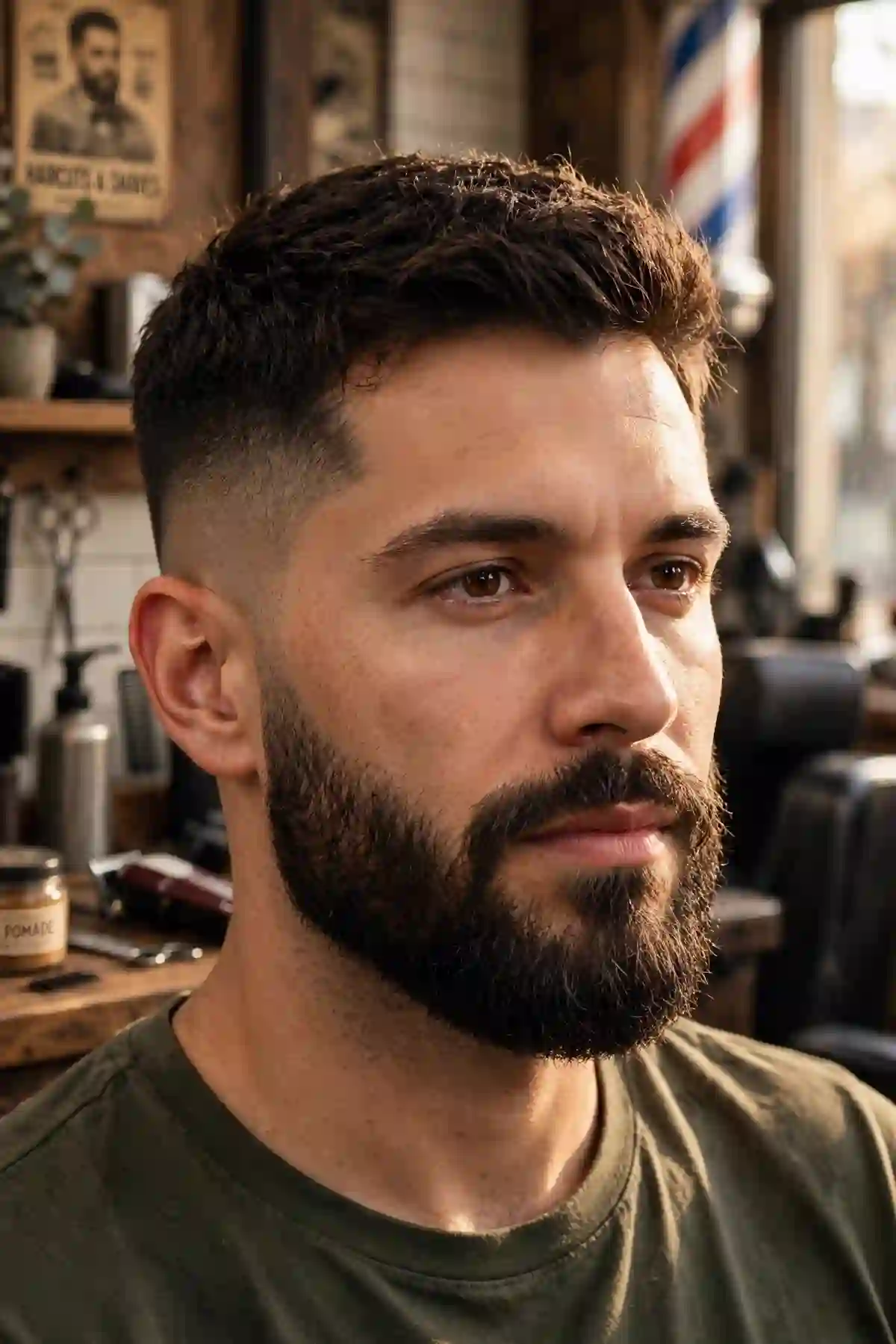
The cheek line is where the beard stops on the cheek. Two options, and the choice changes the whole look:
Whichever you choose, the cheek line should sit at the same height on both sides, and it should connect visually to the sideburn — a cheek line that stops short of the sideburn leaves a notch.
The neckline sits about a finger above the Adam's apple — not at the jawline (too high, looks like a chin strap) and not at the collarbone (too low, looks unkempt). The barber should blend the neckline upward into the beard rather than shaving a hard horizontal line across the throat, and the taper's own neckline at the back of the head should be finished to the same standard: a clean taper at the back with a ragged beard neckline underneath it looks unfinished from every angle except the front.
The honest answer first: there is no single guard that works for every beard. The right starting point depends on the gap between your sideburn length and your beard length — a barber blending into stubble and a barber blending into a full beard are solving two different problems, and one fixed number cannot solve both.
The starting points that work for most men:
And instead of demanding one exact number, it often works better to tell the barber the result you want and let him choose the guards: a soft, close transition for stubble; a gradual blend with a defined shape for a boxed beard; a longer, more conservative blend that preserves the beard's density for a full beard; a natural connection that does not expose the sparse areas for a patchy beard.
For reference, the common guard sizes leave roughly this much hair: a number 1 about 1/8 inch, a number 2 about 1/4 inch, a number 3 about 3/8 inch and a number 4 about 1/2 inch. Brands differ slightly, so a good barber checks the actual length rather than trusting the number alone. Every guard, guard by guard, is covered on the guard numbers page.
Save this on your phone and read it out. The script has three versions — pick the one that matches your beard.
"I want a mid taper fade. Start the blend at my temple, with a number 1 at the bottom, and blend it up through a 2 and a 3. Take my beard down to a number 1 as well. Blend my sideburns into the stubble with no hard line. Keep the cheek line natural, and put the neckline one finger above my Adam's apple. Leave about 2 to 3 inches on top. Here is a photo."
"I want a mid taper fade with a short boxed beard. Start the blend at my temple, with a number 1 at the bottom. Cut the beard at a number 3 and blend my sideburns down into it, so there is no visible line where the hair ends. Give me a defined cheek line, and put the neckline one finger above my Adam's apple. Leave about 2 to 3 inches on top. Here is a photo."
"I want a mid taper fade with my full beard. Start the blend at my temple, with a number 1 at the bottom so the sides stay clean. Keep the beard long, but even it out and shape it — and don't take any length off it. Fade the upper cheek into the sideburn so it does not look thick at the join. Clean the neckline one finger above my Adam's apple. Leave about 2 to 3 inches on top. Here is a photo."
Use the stubble script, and add:
"My beard is thinner in some areas, so work with my natural growth. Keep it short and soft, don't create a high cheek line, and do not use a bare blade on the sides."
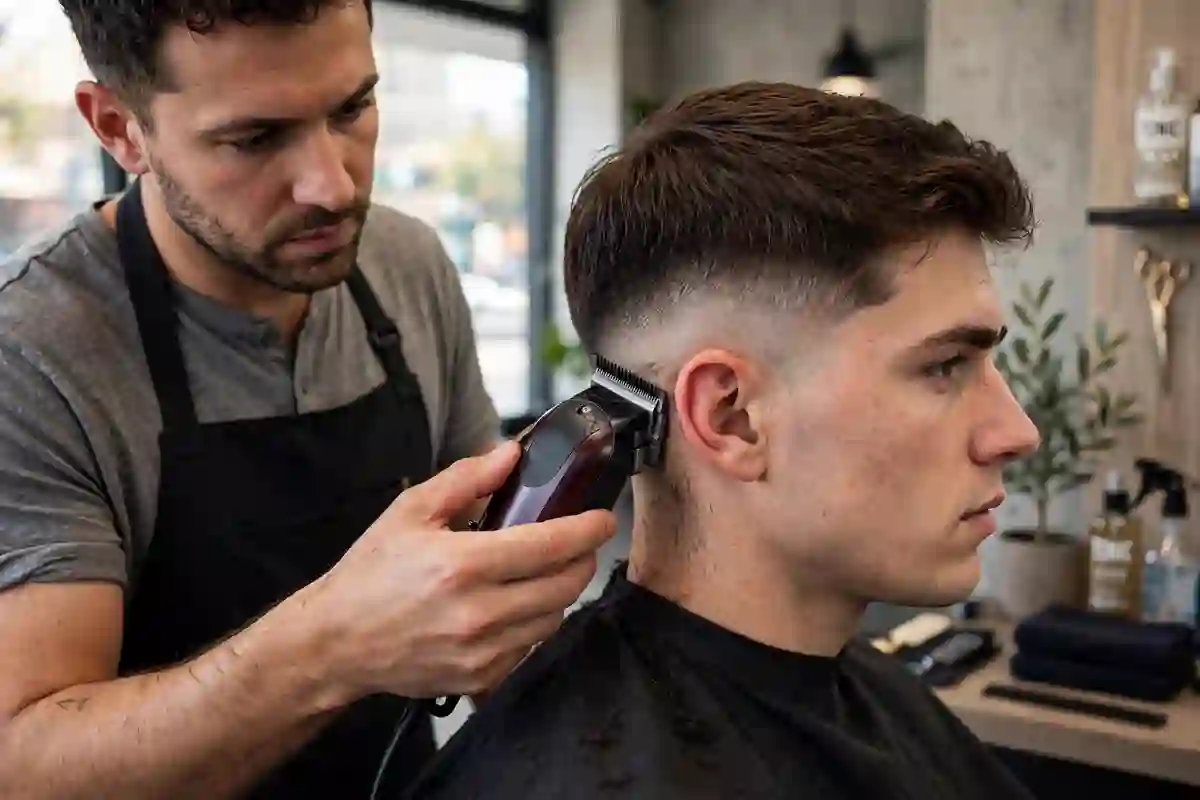
A few tips that make any of these work better:
The beard changes the face shape the taper has to work with, so the pairing matters:
The full face-shape breakdown, taper-only, is on the best mid taper fade for your face shape page.
The haircut and the beard grow at different speeds and need different attention. This is the part most guides skip, and it is why a beard-and-taper combo can look great on day one and messy by day ten.
The taper stays sharp for about two to three weeks. After that the blend softens and the neckline blurs. A full cut every three to four weeks keeps it fresh; a quick taper-and-neckline tidy between full cuts stretches it further. The full grow-out timeline is on the how long does a mid taper fade last page.
The beard needs shaping every week — the cheek line and neckline grow out faster than they look, and a week's stubble above a sharp cheek line ruins the edge. Wash the beard two to three times a week with a gentle wash (not the same shampoo you use on your head, which is too harsh for facial skin), and apply a few drops of beard oil daily to keep it soft — dry beard hair looks dull and sticks out at angles the taper cannot fix. Brush the beard downward after oiling so it sits in the same direction as the blend.
Start with a washed, dried beard, combed down — then run the clock:
The sideburn step. The haircut ends, the beard begins, and there is a visible shelf between them. Fix: ask the barber to fade the sideburn with a 1 guard stepping down into the beard, and to thin the beard's top edge. At home there is no fix — this one is made in the chair, so name it before the cut starts.
The beard is bulkier than the taper. A full beard next to a tight taper makes the head look bottom-heavy. Fix: ask for a softer taper (a 1 or 2 at the bottom, not skin) and for the beard to be thinned at the sides. The taper and the beard should be near the same visual weight.
The cheek line creeps up. Every home tidy takes the line a millimetre higher, and after a month the beard looks smaller. Fix: only shave strays between visits; let the barber reset the line. If it has already crept, grow it back for two weeks before the next cut.
The neckline is too high or too low. Too high and the beard looks like a chin strap; too low and the neck looks hairy from the front. Fix: the finger-above-the-Adam's-apple rule, checked in the mirror with your chin at its normal height — not tilted up, which hides the real line.
Patchy cheeks with a hard cheek line. A carved line across thin growth exposes every gap. Fix: switch to a natural cheek line and a shorter beard until the density fills in, and let the taper carry the sharpness instead.
Dry, wiry beard hair. It sticks out sideways and breaks the blend. Fix: daily beard oil and a brush-down after showering; if the hair is very coarse, a beard balm holds it in place better than oil alone.
These are sample scenarios based on common requests, not real clients.
Danish, 27, first beard. He had worn a skin fade for years and grew a short boxed beard. His barber tapered straight through the sideburn, leaving a gap of skin between hair and beard. Next visit he used the boxed-beard script, the barber blended the sideburn with a 1 guard, and the two halves finally read as one cut.
Omar, 34, full beard, round face. His full beard and low taper made his face look wider. He switched to a mid taper with a defined cheek line and a little height on top, kept the beard length, and the same beard suddenly looked shaped instead of heavy.
Alex, 23, patchy cheeks. He kept asking for a sharp cheek line and the gaps showed more every time. He switched to stubble with a natural cheek line and a shadow taper — the taper carried the clean look, the beard stayed short, and the patches stopped being the first thing people noticed.
Yes — it is the fade most barbers recommend with a beard, because the blend starts at the temple, right where the sideburn begins, so hair and beard can be faded into each other. A high fade starts too high and can leave a gap; a low taper often leaves too much bulk at the join.
The barber fades the hair down through the sideburn and fades the beard up into it, stepping through the guards so there is no hard line or bare gap. The key phrase in the chair is "blend the sideburn, no line" — say it before the cut starts, not after.
There is no single number — it depends on the gap between your sideburn length and your beard length. The usual starting points: stubble pairs with a 0 or 0.5 shadow, a short boxed beard with a 1, and a full beard with a 1 blended upward. The full reasoning is in the guard section above, and the guard numbers themselves are explained on the guard numbers page.
Yes. Keep the beard short, keep the cheek line natural rather than carved, and let the taper do the sharp work. A short beard with clean sides looks intentional; a long patchy beard with a hard cheek line draws attention to the gaps.
The beard needs shaping weekly — cheek line and neckline — while the taper needs a cut every two to three weeks. You do not need a full haircut every week; a weekly beard tidy at home and a taper tidy at the barber's every few weeks keeps both clocks in sync.
No — they are different parts of the cut. The taper is short at the sides by design; the beard keeps its length. What should match is the visual weight: a very tight taper next to a very full beard looks unbalanced, so soften the taper as the beard gets fuller.
A shadow taper is the safer default: it leaves a hint of hair at the bottom, so the sideburn has something to blend into. A skin taper can work with a short boxed beard, but it removes the bridge the beard needs, and it is the version most likely to leave a gap at the sideburn.
Slightly — you are maintaining two edges instead of one, and the beard's edges grow out faster. But the routine is short: five minutes a week at home for the beard, a barber visit every few weeks for the taper. The beard-and-taper combo is one of the lower-maintenance statement cuts, as long as the cheek line is not redrawn at home.
It depends on your beard growth. A sharp cheek line suits dense growth and a short boxed or full beard — it looks sculpted, but it needs weekly upkeep to stay that way. A natural cheek line suits stubble and thin or patchy beards, and anyone who wants the beard to look grown rather than drawn. Either way, the line should follow your natural growth and sit at the same height on both sides — never carve it high to force a shape your cheeks cannot hold.
About one finger above the Adam's apple, blended upward into the beard. At the jawline it looks like a chin strap; down at the collarbone it looks unkempt. Check it in the mirror with your chin at its normal height — tilting your head up hides the real line, and that is how necklines end up in the wrong place.
A mid taper fade with a beard works when the two halves are treated as one cut: the taper fades down, the beard fades up, and they meet at a blended sideburn with no line and no gap. Match the beard length to the taper, set the cheek line and neckline once and only tidy the strays between visits, and keep the two maintenance clocks — weekly for the beard, every few weeks for the taper — in sync.
Pick your beard length, save the matching script above, and tell your barber the sideburn is a blend, not a line. That one sentence is most of the haircut.
← Back to the complete guide: Mid Taper Fade — styles, guard numbers & barber tips
Also see: What is a mid taper fade? — the plain-English definition and who it suits. Mid taper fade guard numbers — what 0.5, 1, 2 and 3 really look like. Best mid taper fade for your face shape — the shape-by-shape guide. Fade vs taper — the wider comparison. And Mid taper fade for Black men — the beard blend on coily hair.