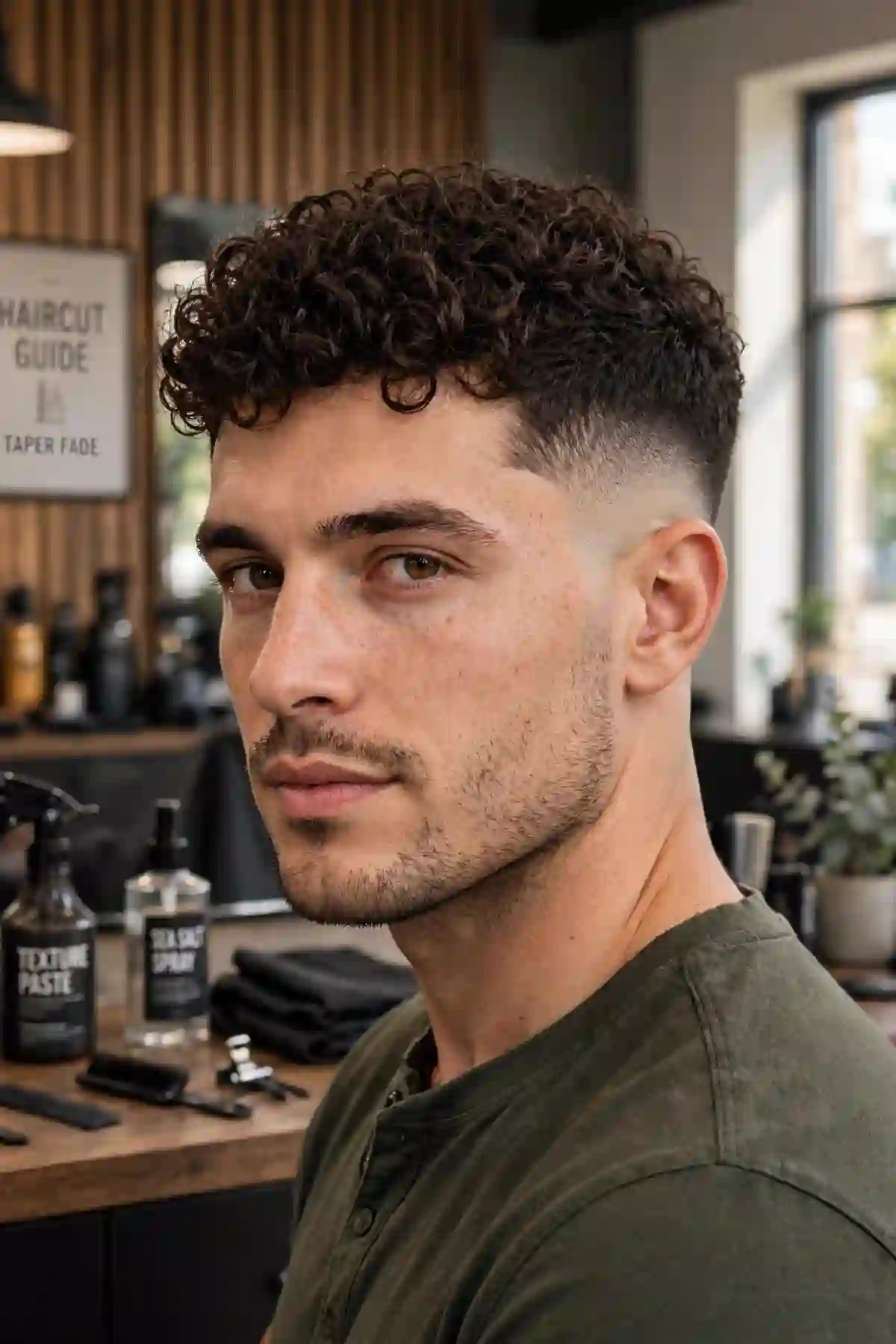
Two cuts, two completely different shapes. The mid taper fade runs its blend in a straight line down the sides. The burst fade bends that blend into a curve around the ear and lets it drop behind it. Same clippers, same guards, same chair — but the silhouette you walk out with, the tops it suits, and the way it grows out are all different.
This guide compares the mid taper fade and the burst fade head to head: how each blend is shaped, which hair and faces each one flatters, how they grow out, and the exact words to ask for each at the chair.
If you want the safer, more versatile cut, take the mid taper fade. If you want the cut with a visible shape of its own — especially with curls or length at the back — take the burst.
The mid taper fade is the middle-height version of the taper fade. The blend starts around the temple, roughly halfway up the sides, and steps down through the guards — usually a 3 at the top of the blend, a 2 in the middle, a 1 at the bottom. The neckline is tapered soft rather than lined up hard.
Its defining feature is evenness: the whole side is shortened in one straight, controlled slope, front to back. That is why it pairs with almost everything on top — a side part, a quiff, a textured crop, a slick back — and why it passes in conservative offices as easily as it does on weekends. The full breakdown is in the complete mid taper fade guide.
How to recognize a mid taper fade:
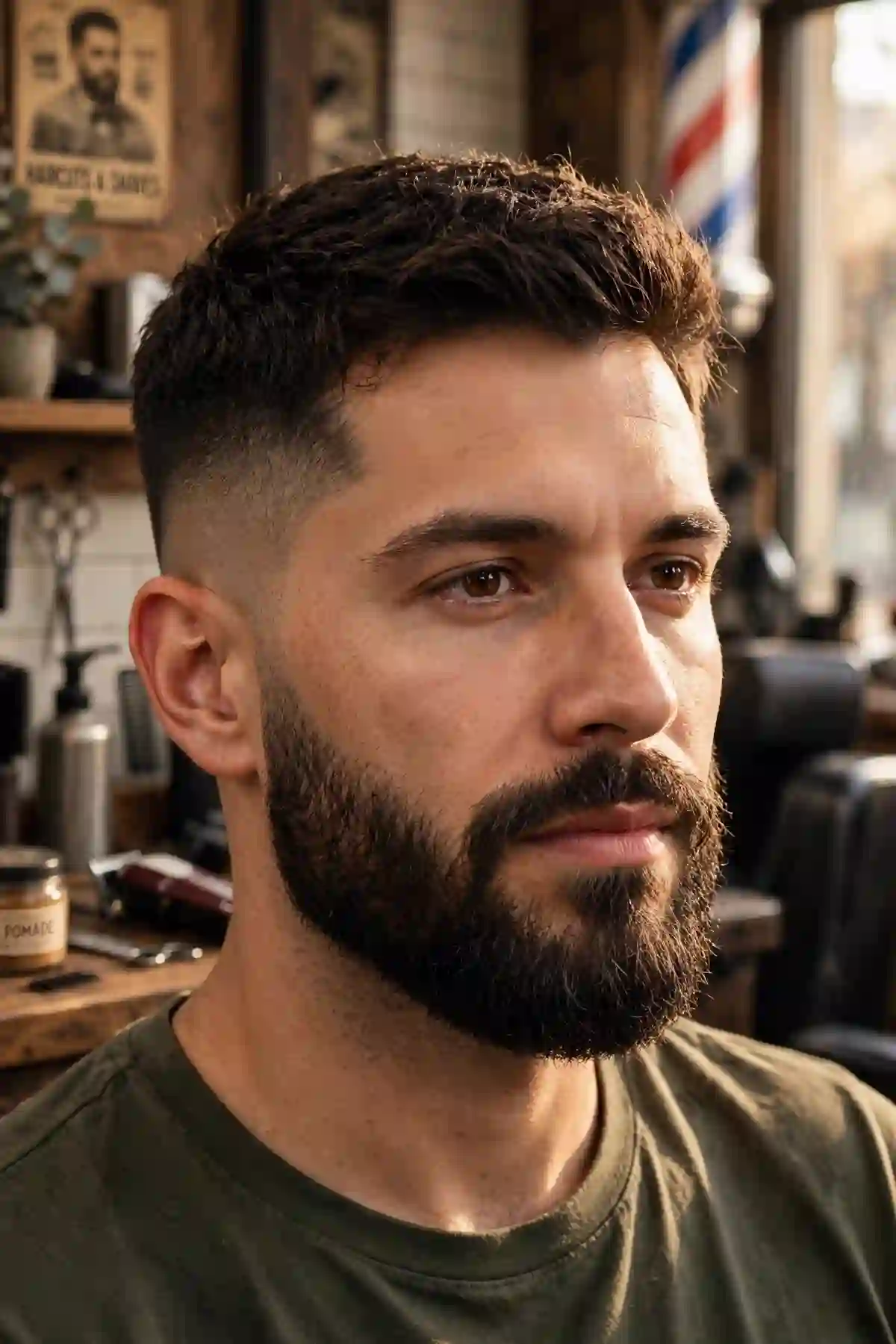
A burst fade is named for its shape. Instead of running straight down, the blend bursts around the ear in a semicircle, then drops down behind the ear toward the neckline. Picture a sunrise behind the ear and you have the shape.
Because the fade follows that curve, two areas keep noticeably more length than on a mid taper: the hair above and behind the ear, and the back of the head above the drop. That kept length is the whole point — it is what lets a burst fade carry a mullet, a mohawk or faux hawk, or a big curly top without the sides looking disconnected.
A burst fade is usually cut with the same guards as any fade — a 1 or 0.5 at the shortest point, blended up to a 2 or 3 — but the barber works in a curve instead of a straight line, which makes it the more technical of the two cuts. A sloppy burst shows its mistakes faster: if the curve is uneven, both sides look different.
There is also a burst taper variant: the same curved shape, but the shortest point keeps visible hair (a 1 or 2 guard, never skin). It is the softer way to wear the shape.
How to recognize a burst fade:
Next time you are saving a reference photo, check three spots:
If you cannot tell, show the photo to your barber and ask: "Is this a burst or a taper?"
| Mid Taper Fade | Burst Fade | |
|---|---|---|
| Blend shape | Straight line down the side | Semicircle around the ear, drops behind it |
| Where it starts | Around the temple, mid-height | Centred on the ear |
| Shortest point | A 1 guard (0.5 for tighter) | A 1 or 0.5 guard, often skin on request |
| Neckline | Tapered soft, natural | Follows the drop; often kept fuller at the back |
| Back of the head | Blended evenly like the sides | Keeps length above the drop — mullet-friendly |
| Best tops | Side part, quiff, crop, slick back, textured fringe | Curly top, mullet, faux hawk, mohawk, long fringe |
| Grow-out | Even and graceful, 3–4 weeks | The curve blurs first; shape holds 2–3 weeks |
| Maintenance | Tidy every 2–3 weeks | Tidy every 2 weeks to keep the curve crisp |
| Work-friendly | Very — the safest of the two | Depends on the top; the fade itself is neat, a mullet top may not be |
| Barber difficulty | Standard blending | Harder — the curve must match on both sides |
| Common mistake | Asking for "burst" and getting this instead | Asking for a burst without saying how wide the curve should be |
| Hair texture | Straight, wavy, curly and coily | Particularly effective with thick, curly and textured hair |
| Style preference | Classic and modern everyday looks | Edgier, more expressive looks |
Read the table as a trade: the mid taper fade spends its shortness evenly across the whole side, so nothing stands out and everything matches. The burst fade concentrates its shortness around the ear, so the shape itself becomes a feature — and features need upkeep.
Both cuts draw on the same guards — what changes is where the barber puts them.
Mid taper fade:
Burst fade:
These are examples, not fixed formulas: the barber adjusts for hair density, head shape and how much contrast you want. And remember, a burst fade does not have to be a skin fade — you can ask for the same curve with visible hair left at the shortest point. The full guard-by-guard breakdown is in mid taper fade guard numbers.
The shape-by-shape detail, with guards and top styles per face, is in best mid taper fade for your face shape.
Yes — and barbers do it often. The common combinations:
If you are switching from one to the other, the good news is that neither needs growing out first. A mid taper fade can be re-shaped into a burst in one visit (the barber takes the curve shorter), and a burst can be evened out into a mid taper in one visit too (the kept length gets blended in). Ask for the change at the start of the appointment, not halfway through.
Mid taper fade:
Burst fade:
The pattern matches the shapes: an even blend ages evenly, a shaped blend ages by losing its shape. A neckline-and-curve tidy at week two is the cheap fix for the burst. The full timeline for the mid taper fade is in how long a mid taper fade lasts.
These are sample scenarios based on common requests, not real clients.
Jayden, 22, tight curls, wanted a burst fade with a curly top. His barber cut the curve wide and kept the back full. The curls sat as one shape and the burst framed them. When he later tried a mid taper fade, the same top looked smaller — the even sides had taken away the volume the curls needed around the ears.
Tom, 34, straight hair, works in sales. He liked burst fades in photos but his hair is straight and fine. His barber talked him into a mid taper fade instead: on straight hair the burst's curve would have shown every step, and the skin-short patch would have made his fine sides look thinner. He kept the photo for the day he grows the top longer.
Andre, 28, growing a mullet. A mid taper fade kept cutting away the back length he was growing. He switched to a burst fade with a tapered neckline — the curve cleaned up around his ears, the back kept growing, and the neckline stayed soft enough for his office.
For a mid taper fade:
"I want a mid taper fade. Start the blend at the temple, a number 1 at the bottom, and blend it up through a 2 and a 3. Keep the neckline tapered and natural. Leave the top as it is — here is a photo."
For a burst fade:
"I want a burst fade around the ears. Curve the blend around the ear and drop it behind the ear — a number 1 at the shortest point, blended up. Keep the length at the back, and keep the top as it is. Here is a photo from the side."
For the hybrid (burst taper):
"I want a burst taper. The burst shape around the ears, but do not take it to skin — a number 1 at the shortest point, and taper the neckline soft."
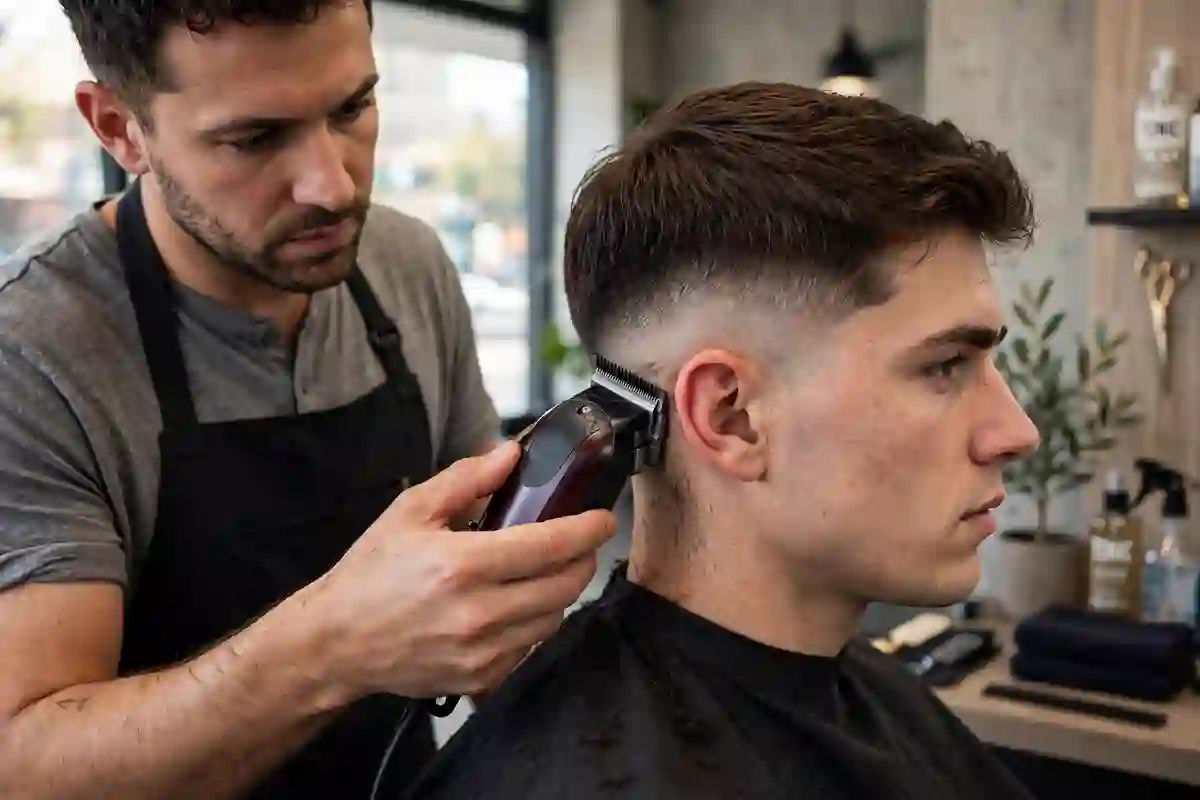
Two details decide a burst fade, so say both out loud: how wide the curve goes (tight around the ear, or wide toward the back) and how much length stays at the back. For the mid taper fade, the deciding words are the height (mid) and the bottom guard. The full guard-by-guard breakdown is in mid taper fade guard numbers, and the wider three-way comparison is in fade vs taper.
The burst curve is uneven — one side sits higher. This is the burst fade's signature mistake. A good barber checks both sides in the mirror before finishing. Ask for the lower side to be matched at your tidy-up visit rather than letting anyone chase it shorter and shorter.
The burst came out looking like a mohawk. The curve was cut too wide or the top left too narrow. Ask for the curve to be tightened around the ear next time, and let the sides above it grow for two weeks.
The mid taper fade looks too plain next to burst photos. That is the cut working as designed — it is the even one. Add the difference on top instead: more texture, a fringe, or length at the back, rather than reshaping the blend.
The back of the burst grows out scruffy first. Normal — the dropped section is the longest short hair on your head. A week-two neckline tidy fixes it for a fraction of a full cut.
You asked for a burst and got a drop fade. They are cousins, not twins: a drop fade's blend dips at the back of the whole head, while a burst is centred on the ear. Show the side-view photo next time and point at the ear.
Not exactly. A burst fade is a fade — it usually blends to a 0.5, a 1 or skin around the ear. But there is a taper version, the burst taper, which keeps visible hair at the shortest point. If you want the shape without the skin-short finish, ask for the burst taper by name.
The mid taper fade. Its blend is even, so it grows out evenly and looks tidy for three to four weeks. A burst fade's curve starts to blur around week two and is mostly gone by week four, so it needs a tidy every two weeks to keep its shape.
Higher than a mid taper fade, yes. The curve is the cut's whole point, and new growth blurs it within about two weeks. A short tidy around the ears and neckline every two weeks keeps it sharp; let it run to four weeks and the burst shape is mostly gone.
It can — with conditions. Keep the sides tight and put height on top, with a tall faux hawk or a textured top, and the burst works on a round face. But a rounded curve worn with a long back can add width instead, so if you want the safer starting point, choose a mid taper fade with a tight bottom and height on top.
Yes. A common version is a mid taper blend with a small burst dropped behind each ear, or a burst fade finished with a tapered neckline. Tell the barber which parts you want curved and which parts straight before he starts.
The same range as most fades: a 1 or 0.5 at the shortest point (skin if you ask), blended up through a 2 to a 3 where the curve meets the longer hair. The guards are not the difference between the two cuts — the shape of the blend is. For what each cut typically uses, guard by guard, see the guard numbers section above.
It is one of the best cuts for curly hair. The curve follows the natural curl pattern, the ears are cleaned up, and the top and back keep the volume curls need. Most burst fade photos you have seen are on curly hair for a reason.
For most straight hair, yes. Straight hair shows the mid taper's straight, even blend at its cleanest, while a burst's curve shows every uneven step. A burst still works on straight hair — especially with a mullet or a faux hawk on top — but it needs a barber who is precise with the curve.
Yes, if the sideburn is handled deliberately: either blended into the beard so the curve flows into it, or disconnected with a clean line. A mid taper fade blends into a beard more softly. Decide which you want before the cut — it changes how the barber finishes the sideburn.
It is the classic pairing. The burst curve cleans up around the ears while the back keeps the length a mullet needs, so the two shapes read as one haircut instead of fighting each other.
The mid taper fade. It suits more faces, more tops and more workplaces, and it grows out forgivingly while you learn what you like. Move to a burst once you know you want the shape — you can switch in a single visit, with nothing to grow out first.
Yes — that is the standard version. A mid taper fade normally finishes at a 1 guard, which leaves visible hair at the shortest point. Skin only enters the picture if you specifically ask for a skin version, or for a 0 at the bottom.
A mid taper fade is the even cut: one straight blend, every top, every office, an easy grow-out. A burst fade is the shaped cut: a curve around the ear that keeps the back alive and makes curly tops, mullets and faux hawks work. Neither is better in the abstract — the mid taper fade wins on versatility, the burst wins on character.
Still torn? Look at your top, not your sides. Classic tops belong on a mid taper fade; curved, curly or longer-at-the-back tops belong on a burst. Save the scripts above, bring a side-view photo, and say the shape out loud before the clippers start.
← Back to the complete guide: Mid Taper Fade — styles, guard numbers & barber tips
Also see: Fade vs taper — the wider three-way comparison. Mid taper fade vs low fade — the closest comparison. Mid taper fade guard numbers — what 0.5, 1, 2 and 3 really look like. And Best mid taper fade for your face shape — the shape-by-shape guide.